AI Engineering · Experimentation
How Intelligent Are LLM Routers?
An empirical exploration of the trade-offs between accuracy, cost and intelligent model routing.
A note on how I leveraged AI for this blog
I have leveraged AI throughout this experimentation and blog writing process.
-
Research and building understanding: Paired with AI to build my understanding of the different foundational techniques behind LLM Routers, explore the research papers and understand how different routers work internally.
-
Building the evaluation framework: Leveraged AI to build the evaluation harness, generate representative engineering tasks, define evaluation rubrics and review the quality of the generated task sets.
-
Analysing the results: Paired with AI to analyse the results generated by the evaluation harness, look at them from different perspectives, challenge my thought process and identify patterns requiring further investigation.
-
Articulating my thoughts: I leveraged AI as a sounding board while structuring this blog, organising my thoughts and refining the language to articulate my observations better.
Throughout this process, I remained actively involved in defining the objectives, shaping the experiments, questioning the results and developing the point of view presented in this blog.
Motivation behind exploring LLM Routers
I have been using LLMs extensively for my day-to-day work - right from building my understanding of technology concepts, developing software, drafting emails and customer communications, to writing proposals and preparing customer deliverable related reports.
While leveraging these models for my day-to-day work, I have often questioned myself If I am using the right LLM for the different types of work I do.
Currently, I am on a Claude Max subscription, which gives me the luxury of using Opus for almost all my tasks. But do all these tasks really warrant the use of a model like Opus?
For example, while writing a proposal, Opus might be the right choice to help me structure my thoughts, reason about the problem and articulate the solution. However, once the proposal is written, for minor improvements and refinements, Sonnet or even Haiku might do an equally good job.
While I am already grappling with solving a business or a technology problem, constantly thinking about which LLM to use adds unnecessary cognitive load on my tiny brain. Thinking about choosing the right model and switching them also tend to break the flow of my work, especially when I am working on multiple tasks in parallel.
This is where the concept of LLM Routers becomes important.
What if I could offload the decision of choosing the right LLM to another system? All I would need to worry about is articulating the problem correctly and providing the right context. The router would decide on my behalf which LLM should service the request.
All of this becomes even more relevant in the context of production systems powered by LLMs servicing thousands or millions of requests. Using the most capable model for every request may not necessarily be the most cost-efficient way of building these systems.
But when we ask a router to make this decision on my behalf, we are essentially delegating a part of our thinking process to another system. For this to be effective, the router needs to be intelligent enough to understand the nature of the problem and assess the capabilities of different LLMs in the context of that problem.
To add to it, routers are themselves not free. There is a cost associated with hosting them or consuming them as a service, along with the additional latency they introduce.
With all this background, I started exploring different LLM Routers, trying to answer a few questions:
-
Is there an actual cost savings through intelligent model selection?
-
How do different LLM Routers fundamentally work?
-
How effective are they, at least in the context of the engineering work I do?
-
Do I really need sophisticated routing techniques, or can simpler approaches be equally effective?
Some of the observations from this experiment helped me build my own understanding of how to go about selecting LLM Routers.
What exactly is LLM’s Router’s Job?
In simple words, an LLM Router receives a request and decides which LLM should service that request - a cheaper one or a stronger one.
However, before getting into how these routers work, I think it is important to establish what one means by a good routing decision.
Suppose I give the same task to Haiku, Sonnet and Opus. Haiku produces an answer that meets all my acceptance criteria, whereas Opus produces a marginally better answer.
Which of these is the right model for the task?
If I were evaluating the models purely in terms of answer quality, perhaps Opus would be my choice. However, if Haiku’s answer already meets the expectations of the system, would spending significantly more on Opus be justified?
So, there is a difference between identifying the best model for a task and identifying the minimum sufficient model for a task.
In the context of this blog, the objective of intelligent routing is to identify the most cost-effective model capable of servicing a request while meeting the desired level of correctness and quality.
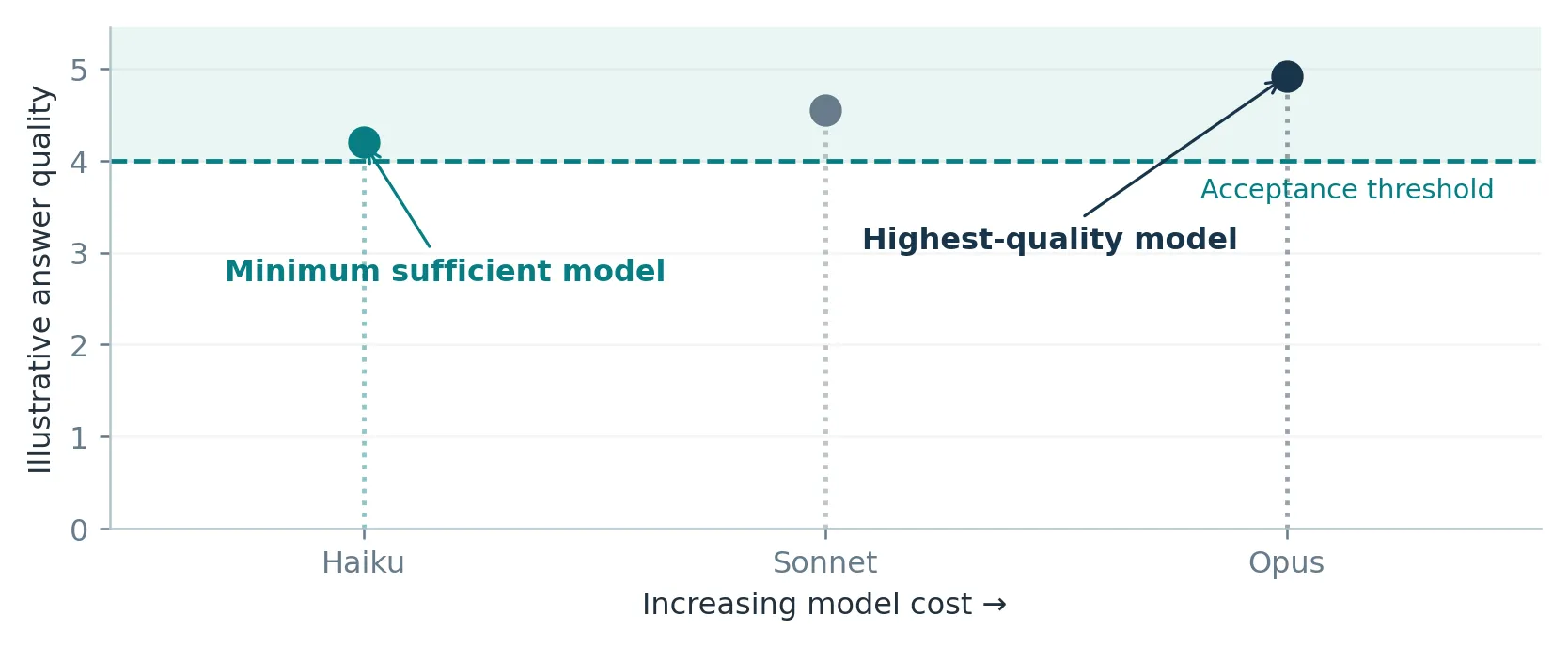
Figure 1. Best model vs minimum sufficient model. Conceptual illustration; not experimental data.
There are broadly two approaches to solving this problem.
Predictive Routing
The router analyses the request and decides which LLM should service it before any model generates an answer. The router is essentially making a prediction about how well different models are likely to perform on the task at hand.
Cascading Routing
A relatively cheaper model attempts to answer the request first. The generated answer is then evaluated using objective checks, a verifier or some measure of confidence. If the answer does not meet the expected criteria, the request is escalated to a more capable model.
An important distinction between these two approaches is that cascading routers have access to additional information - the actual answer generated by the cheaper model.
Predictive routers have to make their decisions without this information.
For this PoV, I have limited my exploration to Predictive Routing.
Foundational techniques behind LLM Routers
Before we dive deep into experiments conducted, their results and the learnings, let’s try understanding the foundational principles on which these LLM routers are built so that we understand them better and which router fits better for our context. I have tried explaining them in a simple language as I understood them.
Supervised Classifier
-
Uses a general-purpose model, fine tuned for routing. The classifiers generally would output a probability score if a stronger model is needed basis the prompt given as input
-
These classifier models are generally fine tuned on model efficacies sources from the community. For example, RouteLLM’s Bert is an example of a Supervised Classifier. The model is tuned based on user votes given on ChatBots arena where they are given a question and answers given by different LLM models (without disclosing the models themselves) and they vote which LLM answer is better.
-
On the router’s consumer side, a threshold is configured. For example, if the classifier gives a probability less than threshold configured as 0.5 that means a weaker model would be effective. If its above the threshold score means a stronger model is recommended.
-
Threshold should be configured basis the context of your system, types of questions/queries/prompts being sent to the model
-
These classifiers claim that they generally work well in context of general purpose systems
Matrix Factorization
-
This technique works with a model which is trained to learn different representations of prompt and different LLMs. It also learns a score function capturing how well a LLM is likely to perform for a given prompt. These learned representations implicitly capture features of a prompt like its complexity, reasoning requirement and domain. In context of LLM, it also captures their performance in context of those features
-
At runtime, an embedding is created for an input query prompt. The embedding is combined with the learned embedding of each LLM to calculate how well a model is expected to perform on that query
-
It then uses this output to produce a probability if a stronger model will outperform the cheaper model.
-
The routers using this technique than uses this probability value and a configurable threshold to make a decision on which LLM model should handle the query
-
RouteLLM’s MF technique uses this routing technique
Generative LLM Routers
-
Uses a general purpose LLM model specifically trained on data (synthetic/context specific) to make decisions directly/indirectly for LLM model to use for a prompt at hand.
-
Using LLM for making decision on model also allows user to send custom instructions to the Router on how would it decide on model routing basis the prompt allowing contextual routing decisions
-
Arch-Router 1.5B is an example trained with synthetic data. It requires configure task types and domains along with their descriptions
-
These task types and domain labels with their descriptions are passed to the Router along with the prompt. The Router then outputs the task type and domain for the prompt. Based on your context, a mapping can be maintained - for a specific task type and domain type which model is suited. The prompt then can be then routed to the configured model
LM Based Decision Models
-
These types of the routers are the most recent one - they use Language Model based Decision Models like the Jev Model
-
These models were created for decision making and not for routing in general
-
The way it works is you give the prompt for which you want to decide the LLM model for, an instruction what’s required of the model and the decision labels with descriptions.
-
The model outputs every decision label with its priority. One with the high probability is the model you can use to route the prompt to
Classifier plus usage statistics
-
Such router types are mix of Supervised Classifiers and live usage data
-
Most commercial routers use this technique
-
Classifier is used to figure out the task type basis of the prompt text. Monitoring the data from community - which model most frequently was used for that particular task type is then returned as the model of choice from the router
-
OpenRouter Auto is an example which leverages this technique
If you see the pattern, these different routing techniques rely on fundamentally different sources of knowledge to make their routing decisions.
I also evaluated certain Routers which are proprietary for which the underlying architecture is not known. For example, NotDiamond
Now that we know how these LLM Routers operate, let’s get back to evaluation methodology and the results observed as part of my experimentation.
LLM Router Evaluation Methodology
Before evaluating the different LLM Routers, I wanted to establish if intelligent model selection is really helpful. After all, if a relatively cheaper model can already meet the expectations of the system, a router may not even be needed.
Step 1: Building an evaluation harness
I wanted my evaluation to be grounded in the kind of engineering work the teams at Sahaj do on a day-to-day basis rather than relying entirely on general-purpose LLM benchmarks.
I leveraged patterns from some of the developer sessions at Sahaj to identify different task types spanning the software development lifecycle.
Based on this, I created a dataset of 99 representative engineering tasks across 15 categories.
| Lifecycle phase | Task types |
|---|---|
| Discovery | User stories, backlog creation, requirements review |
| Design | Architecture decisions, data and API design |
| Development | Code generation, bug fixing, refactoring, SQL generation |
| Testing | Unit test generation |
| Review | Code and PR review |
| Operations | Incident analysis, DevOps and dependency management |
| Knowledge | RAG Q&A, code explanation, fact-based questions |
I leveraged LLMs to generate these tasks based on detailed specifications for each task category. Separate reviewer agents evaluated them for correctness, realism, difficulty and the effectiveness of the evaluation criteria.
While some of these tasks were inspired from real developer sessions from Claude, the actual scenarios and data were synthetic and did not contain client material.
For every task, I also defined what constitutes a correct answer.
Of the 99 tasks:
-
51 could be evaluated completely objectively using mechanisms such as executable tests, SQL result comparisons and schema validation.
-
43 leveraged a combination of objective checks and LLM-based evaluation.
-
Only five depended entirely on an LLM judge.
For tasks where correctness alone was not sufficient to establish how good an answer was, I also defined quality rubrics (for about 85 of them out of 99 tasks).
For example, in the context of incident analysis, I was interested not only in whether the model identified the root cause, but also in the quality of evidence provided, whether it ruled out alternative causes and whether its recommendations were actionable.
Step 2: Creating a separate dataset for difficult tasks
One interesting observation during the initial creation of my evaluation harness was that the cheaper models were capable of solving many of the tasks I had categorised as hard.
This meant that my representative dataset had relatively few tasks on which I could test a router’s ability to identify the need for a stronger model.
To address this, I created a separate dataset of nine difficult, long-context engineering tasks. I could have created more of such tasks but was conscious of the spend for creating them
These involved activities such as reviewing large multi-file changes, analysing logs spanning multiple services and reasoning over large specifications. The input sizes ranged from approximately 19,000 to 70,000 tokens.
I also introduced an additional criterion for accepting tasks into this dataset. Haiku 5.5 had to fail the task in at least two of three initial attempts, while Sonnet or Opus had to demonstrate that the task was solvable.
This dataset was deliberately constructed as a stress test rather than being representative of day-to-day engineering work at Sahaj.
Step 3: Establishing a baseline - the Oracle
-
Once the evaluation harness was built, I ran all 108 tasks against four models from Anthropic - Haiku 4.5, Haiku 5.5, Sonnet 5.5 and Opus 5.5.
-
Given the non-deterministic nature of LLMs, each task was executed three times against each model. A model was considered to have passed a task if it answered correctly in at least two of the three runs. Costs and quality scores were averaged.
-
For tasks requiring an LLM judge (tasks for whom quality rubrics were defined), I leveraged an OpenAI model to reduce the possibility of Claude models favouring responses generated by other Claude models.
-
I also wanted to establish whether the LLM judge’s interpretation of what constitutes a good-quality answer was aligned with that of a software engineer. For instance, does an answer rated 4 or 5 by the LLM judge also meet the quality expectations of a software engineer?
-
To establish this, I performed a blind human evaluation of 17 answers using the same rubrics, without knowing which model had generated the answer or the scores assigned by the LLM judge.
-
The LLM judge and I agreed on the pass/fail decision for 14 of the 17 answers (82%). The LLM judge was marginally stricter than I was in assessing correctness.
-
While the sample size was relatively small, this gave me reasonable confidence that the LLM judge’s acceptance criteria were broadly aligned with those of a software engineer
Now that I had data about how every model performed on every task, I could identify the cheapest model that was capable of answering each task correctly, wherever at least one model passed.
I referred to this benchmark as the Oracle.
The reason I call it an Oracle is that it has the benefit of hindsight. It already knew how different models performed on a particular task and can therefore make the model selection decision based on actual outcomes.
A predictive router does not have this hindsight.
The Oracle gives me a benchmark for what I could potentially achieve through intelligent routing, within the set of models and acceptance criteria used in my evaluation.
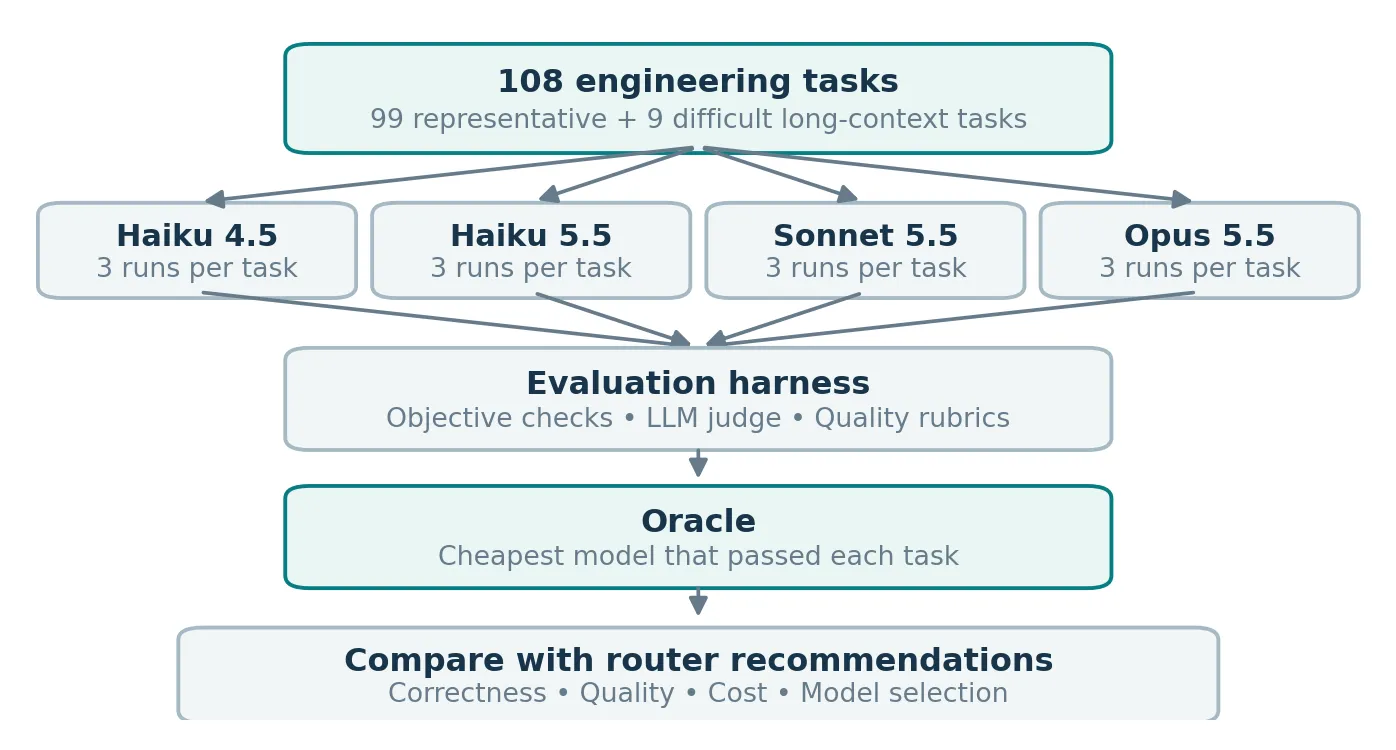
Figure 2. Evaluation methodology and the Oracle. Every candidate model answers each task three times; router recommendations are replayed against saved results.
Step 4: Understanding the results of the baseline
The following table captures the performance of the individual models on my 99 representative engineering tasks.
| Model | Correctness | Quality (out of 5) | Execution cost |
|---|---|---|---|
| Haiku 4.5 | 36% | 3.20 | $0.51 |
| Haiku 5.5 | ~86% | 4.23 | $0.20 |
| Sonnet 5.5 | 92% | 4.43 | $2.94 |
| Opus 5.5 | 95% | 4.38 | $5.59 |
| Oracle | 97% | — | $1.08 |
Execution cost represents the recorded model inference cost for the entire 99-task dataset, using the pricing applicable to my experiments.
The first thing that struck me was how well Haiku 5.5 performed.
It was capable of answering approximately 86% of my representative engineering tasks correctly at less than 4% of the cost of always using Opus.
The Oracle achieved a correctness of 97% while bringing down model execution costs by approximately 81% compared to always using Opus.
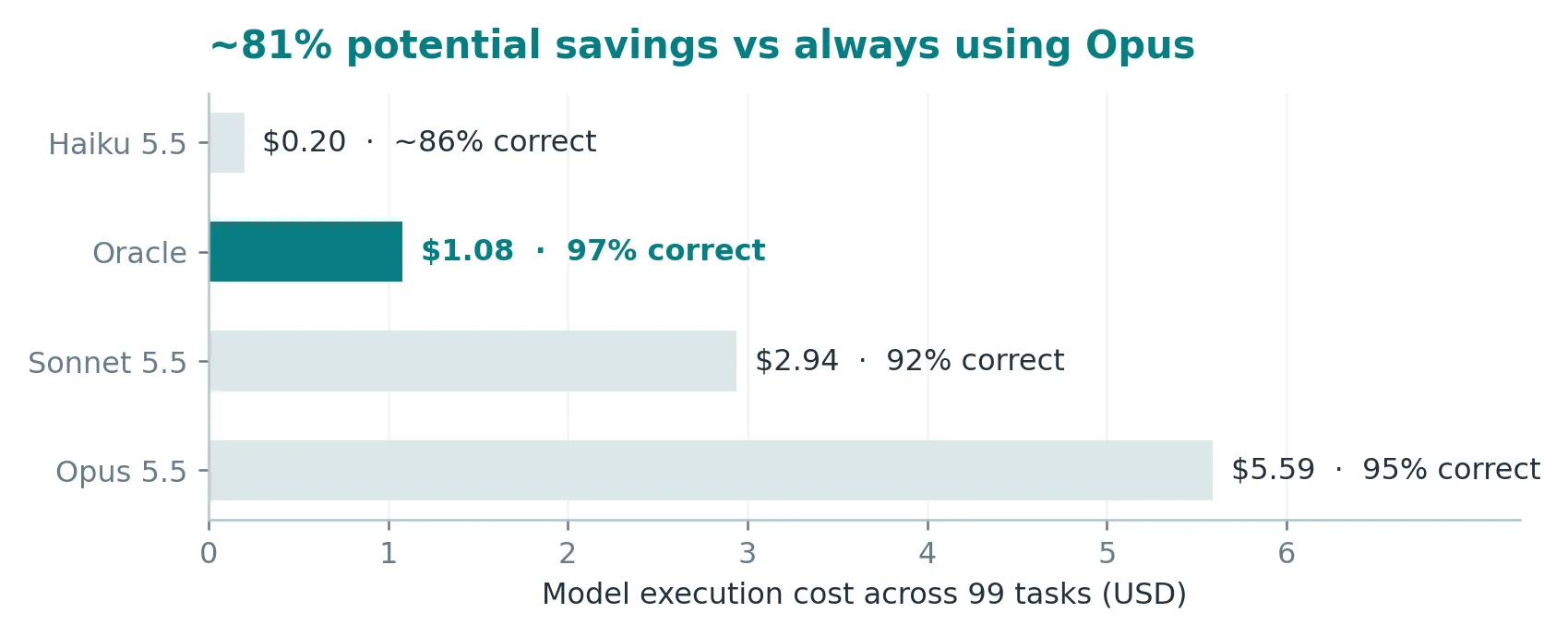
Figure 3. Potential for intelligent routing: model execution cost and correctness on the 99 representative tasks.
This establishes that there is significant potential for intelligent routing, at least in the context of the workloads I evaluated.
Next step was to check - can an LLM Router get anywhere close to what my Oracle was able to achieve?
Step 5: Testing the effectiveness of the LLM Routers
To evaluate the effectiveness of the different LLM Routers, I passed the same set of tasks through each of the routers and captured the LLM recommended by them for every task.
Since I had already executed every task against all the candidate LLMs as part of establishing the Oracle baseline, I knew how each of these models had performed in terms of correctness, answer quality and execution cost.
I therefore did not have to execute the tasks again against the models recommended by the routers. Instead, I leveraged the previously recorded evaluation results for the recommended models to establish:
-
Model selection accuracy: How often did the model recommended by the router match the model identified by the Oracle?
-
Correctness: For how many tasks had the recommended model produced a correct answer during the baseline evaluation?
-
Answer quality: What was the quality of the answers produced by the recommended models?
-
Execution cost: What would be the total model execution cost if the tasks were serviced by the models recommended by the router, and how did this compare with the Oracle?
This allowed me to evaluate the effectiveness of the routing decisions independently of the actual execution of the tasks, without having to incur the cost of running the evaluation harness against the LLMs again.
However, simply measuring how often a router matches the Oracle does not necessarily give the complete picture.
Consider three possible routing outcomes:
-
Optimal routing: The router selects the cheapest model that meets the acceptance criteria.
-
Over-routing: The router selects a more expensive model that passes, even though a cheaper model would have met the acceptance criteria.
-
Under-routing: The router selects a cheaper model that fails the task when a more expensive model could have succeeded.
The implications of these routing errors are quite different. Over-routing could result in unnecessary expenditure, whereas under-routing could lead to incorrect answers, retries, human intervention or downstream failures.
Depending on the nature of the production system, the costs associated with these errors could be significantly different.
Step 6: Understanding the results of evaluating the LLM Routers against the 99 SDLC tasks
| Routing strategy | Matched Oracle | Oracle match | Correctness | Execution cost |
|---|---|---|---|---|
| Oracle | 99/99 | 100% | 97% | $1.08 |
| Always Haiku 5.5 | 85/99 | 86% | 86% | $0.20 |
| Always Sonnet | 9/99* | 9% | 92% | $2.94 |
| Always Opus | 2/99* | 2% | 95% | $5.59 |
| Random (Haiku/Sonnet) | 45/99 | 45% | 91% | $1.74 |
| RouteLLM BERT | 26/99 | 26% | 88% | $2.12 |
| RouteLLM MF | 85/99 | 86% | 86% | $0.20 |
| LLMRouter KNN | 83/99 | 84% | 88% | $0.44 |
| Arch-Router | 64/99 | 65% | 91% | $2.09 |
| Jev | 71/99 | 72% | 93% | $1.84 |
| Jev-score | 35/99 | 35% | 93% | $2.67 |
| OpenRouter Auto | 59/99 | 60% | 90% | $1.50 |
| Not Diamond | 5/99 | 5% | 96% | $4.51 |
| Task-type rule | 67/99 | 68% | 92% | $2.10 |
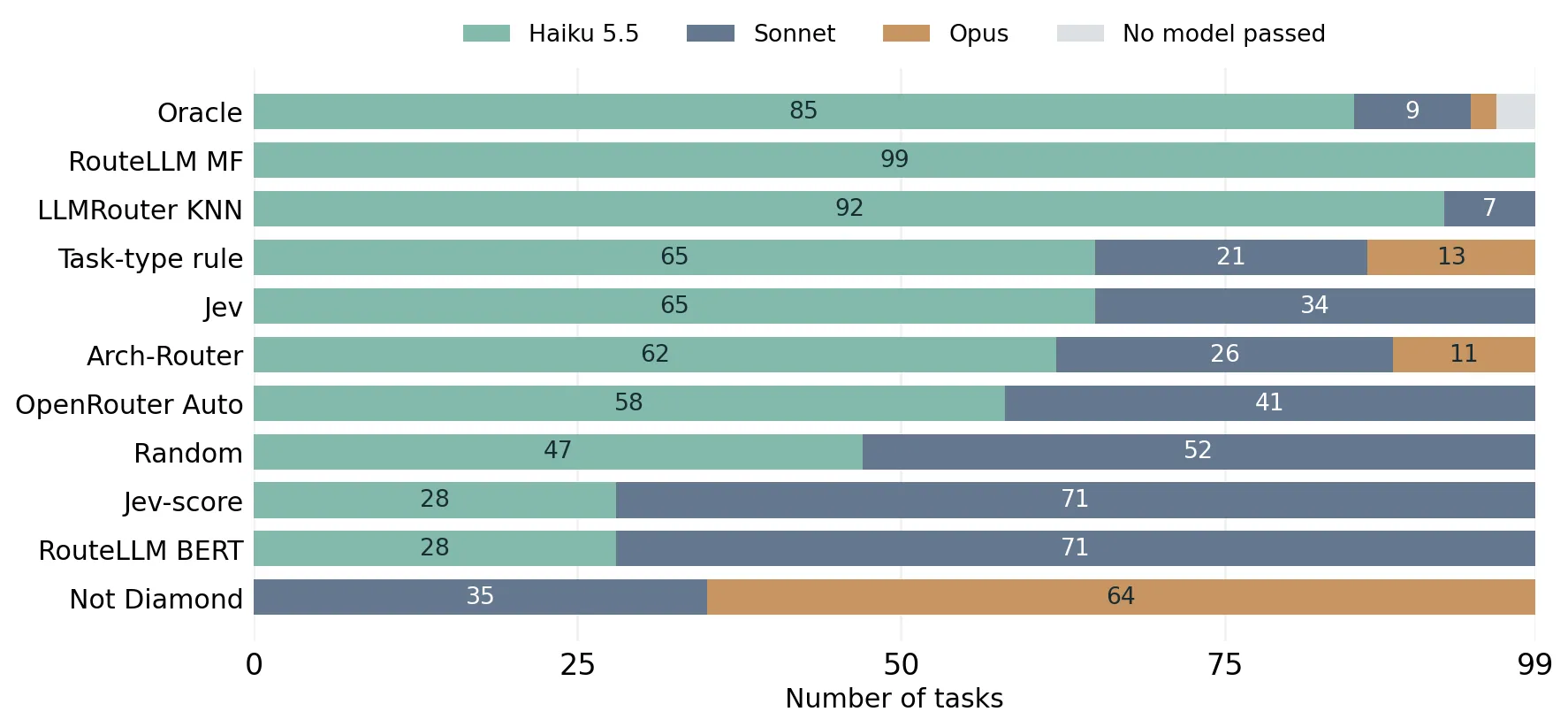
Figure. Distribution of model recommendations across the 99 SDLC tasks.
The above costs represent the execution cost of the selected models and do not include router operating costs.
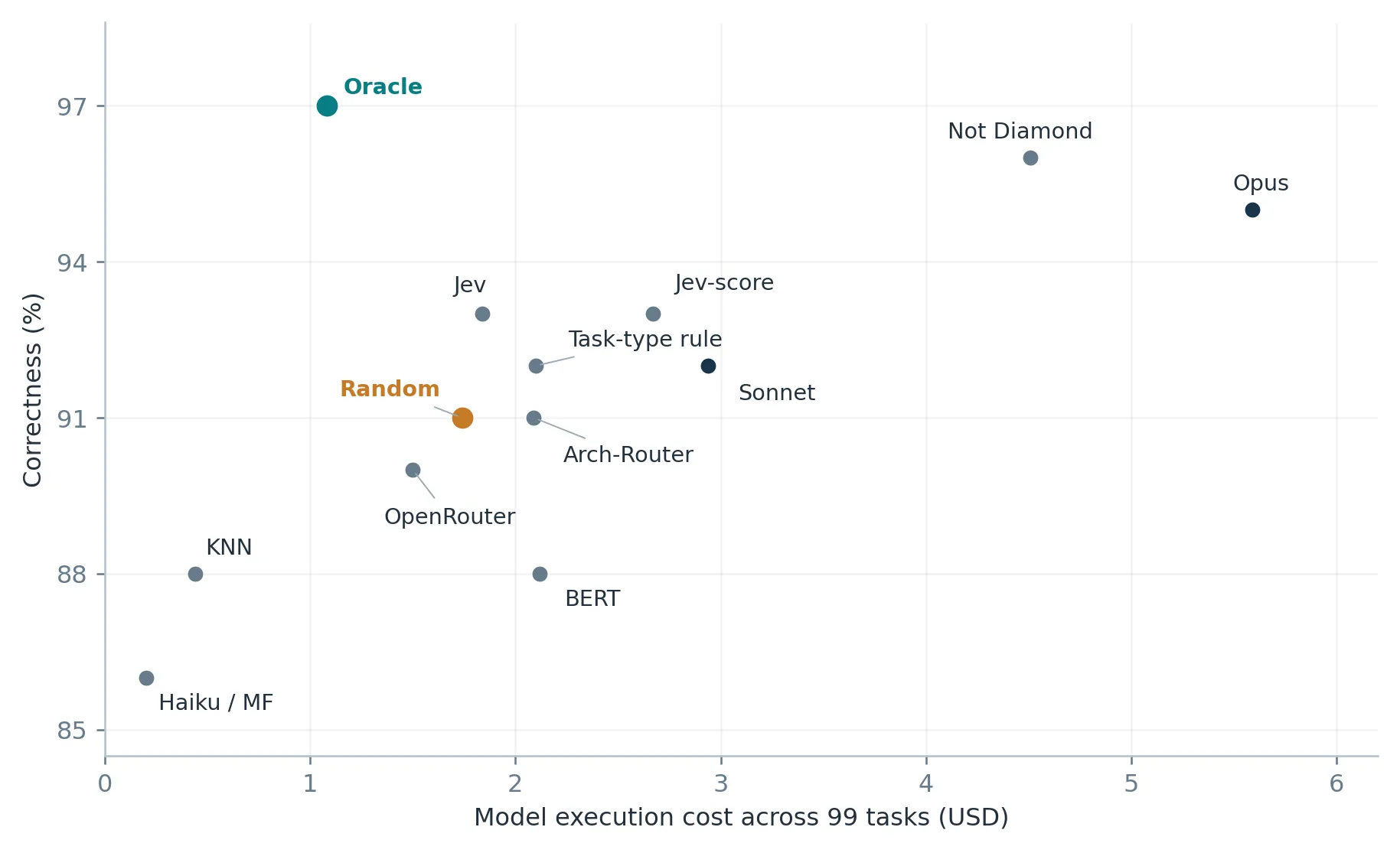
Figure 5. Correctness vs model execution cost. The desirable region is towards the top-left. Router operating costs are excluded.
Surprisingly random routing performed relatively well compared to several of the sophisticated routing techniques. Following were few of the observations from the data:
-
“Random routing” routed approximately half the tasks to Haiku and the remaining half to Sonnet resulted in a correctness of 91%. Many of the routers I evaluated performed within a few percentage points of this.
-
“Not Diamond” achieved the highest correctness amongst the evaluated routers. However, it recommended Opus for 64 of the 99 tasks, even though Haiku was capable of solving a large majority of these tasks. Hence, it was the most expensive Router amongst all.
-
Jev presented a good cost-correctness trade-off, achieving 93% correctness at approximately 37% less execution cost than always using Sonnet.
-
KNN-based approach of RouteLLM, on the other hand, achieved 88% correctness at a cost of $0.44. The trade-off fits a system where a wrong answer costs little and cost matters most. It does not fit where correctness is the priority.
-
None of the evaluated routers achieved a combination of correctness and cost comparable to that of the Oracle.
The results should not be interpreted as establishing that random routing is generally as effective as intelligent routing considering the sample set used for evaluating this was a small set of representative tasks.
My learnings from these experiments
Beyond the comparative performance of these routers, following were some of my observations and learnings that helped shape my understanding of the routing problem:
1. What appears complex to an engineer may not necessarily be complex for an LLM
While creating the evaluation dataset, I categorised tasks as easy, medium and hard based on my understanding of their reasoning requirements and complexity.
During my first round of evaluation, Haiku 5.5 was able to solve 15 of the 20 tasks I had categorised as hard.
This made me realise that my understanding of complex tasks is very different from that of LLMs.
While a particular architecture problem might appear complex to an engineer, the LLM might already have a good understanding of similar patterns. On the other hand, a seemingly straightforward problem might contain a subtle constraint that a cheaper LLM struggles to reason about.
Human perception of task complexity may therefore not necessarily be indicative of the model capabilities required to solve that task.
This is particularly relevant in the context of predictive routing. A router has to establish which characteristics of a prompt are genuinely indicative of the capabilities required to answer it correctly.
The most reliable way to check effectiveness of a selected Router to route a prompt to a “minimum sufficient model” is to test with data grounded in context of one’s problem domain and complexity and graded answers.
2. Higher Correctness does not necessarily indicate better routing intelligence
One of the observations from the above results was the difference between the correctness achieved by the models recommended by a router and how often the router’s recommendations matched those of the Oracle.
For example, Not Diamond achieved a correctness of 96%, which was the highest amongst the LLM Routers I evaluated. However, its model recommendations matched those of the Oracle for only 5 of the 99 tasks.
For 90 tasks, Not Diamond recommended a more expensive model that passed, even though a cheaper model was capable of answering the question correctly. It recommended Opus for 64 of the 99 tasks, despite Haiku being capable of solving 85 of them.
On the other end of the spectrum, RouteLLM’s Matrix Factorization router matched the Oracle’s recommendations for 85 of the 99 tasks. Looking at this metric, one might conclude that it was the most effective router amongst the ones evaluated. However, at the configured threshold of 0.5, it recommended Haiku for all 99 tasks. Essentially, it’s the only Haiku strategy which would have achieved the same result.
Thus, neither overall correctness nor how frequently a router’s recommendations match those of the Oracle can independently establish the effectiveness of an LLM Router. It becomes important to look at these metrics in conjunction with execution cost and the distribution of model recommendations
3. Routing intelligence also depends on the routing policies configured
LLM routers like RouteLLM Bert/MF, Jev-score return scores indicating the probability of needing a stronger model for the input prompt. One can then configure threshold values for their systems which are used to decide that if the returned score crosses a certain threshold use a stronger model, otherwise use the cheaper one. These thresholds have to be calibrated in context of your systems rather than leaning on provided defaults.
Consider the experiments with RouteLLM’s MF router.
I initially configured it with a threshold of 0.5. At this threshold, it recommended Haiku for every one of my 99 representative engineering tasks.
When I reduced the threshold, its behaviour changed significantly.
| Threshold | Tasks routed to Sonnet | Tasks passed |
|---|---|---|
| 0.500 | 0 | 85 |
| 0.300 | 7 | 85 |
| 0.188 | 38 | 85 |
| 0.116 | 84 | 89 |
| 0.100 | 90 | 89 |
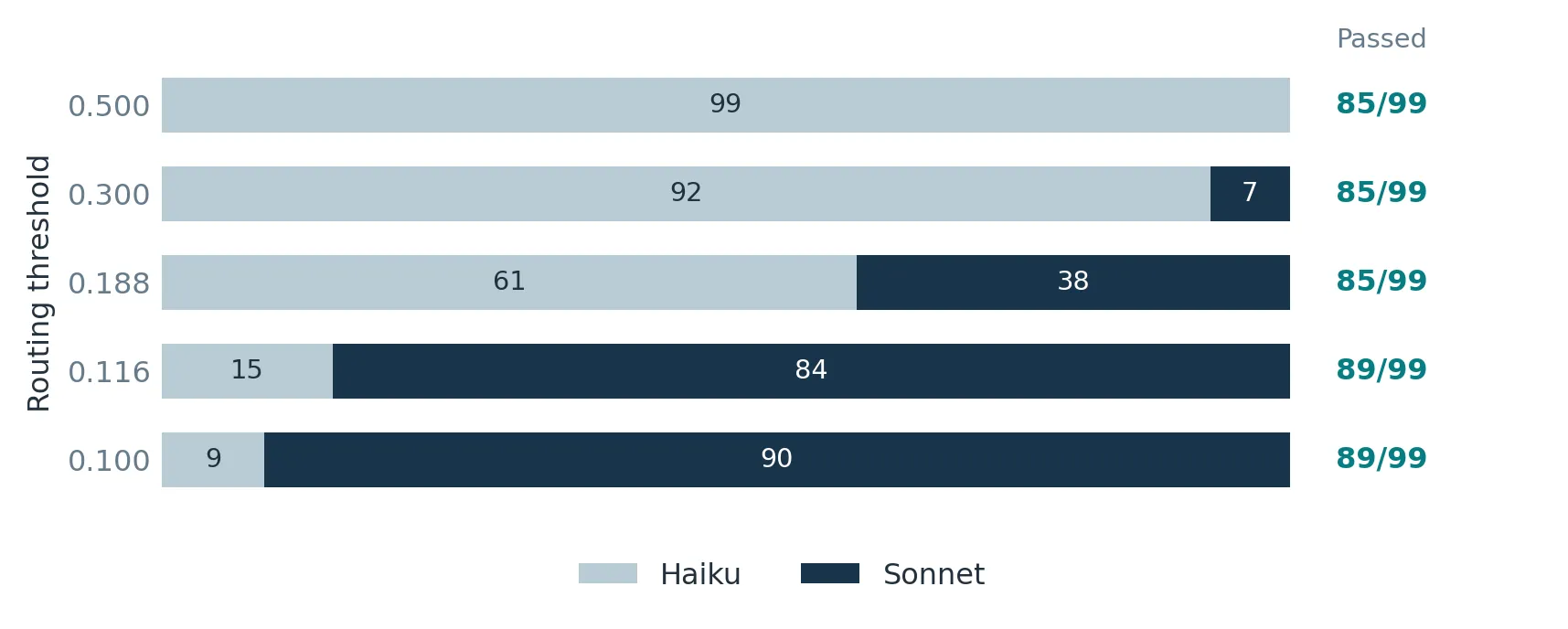
Figure 6. Routing intelligence vs routing policy. Escalating more tasks to Sonnet does not necessarily improve aggregate correctness.
The underlying routing model had not changed. What had changed was the policy used to translate its scores into routing decisions. Given the cost and correctness expectations of the system, identifying an appropriate threshold becomes important for making effective routing decisions.
However, while evaluating a router for a system, it is equally important to establish whether the scores generated by the router can meaningfully differentiate between tasks that can be serviced by a cheaper model and those that would benefit from using a stronger model.
For example, if the scores generated by the router for tasks that were successfully solved by a cheaper model significantly overlap with the scores for tasks that required a stronger model (as established through our baseline evaluation), defining meaningful threshold-based routing policies becomes a challenge.
In such a scenario, even with threshold calibration, it becomes difficult to selectively route tasks to stronger models without also escalating a significant number of tasks that could have been serviced by cheaper models.
4. Contextual routing introduces its own set of challenges
I also wanted to explore whether an understanding of the different types of engineering work at Sahaj could provide a useful foundation for routing decisions.
To explore this, I created a relatively simple task-type-based routing strategy. Examples of task-types chosen were pr-review-task, code generation, writing acceptance criteria, and so on and so forth. For each task category, I leveraged the observed performance of different LLMs on the other tasks belonging to that category to determine an appropriate model (used the Oracle Insights). Using the known category of every task, this approach achieved 92% correctness though at a higher execution cost of $2.10 - almost double that of Oracle’s cost.
I then leveraged Arch-Router to identify the task category from the prompt and applied the same model selection rule. Arch-Router achieved 91% correctness at a comparable cost.
Task type based routing overlooks the nuance of task type’s complexity. For example, a task of type “Architecture Review” may be simple enough to answer by a cheaper model or can be complex enough warranting a larger model. I had also added certain fact-based questions under the mask of a specific task type which could have been easily answered by a Haiku but was instead sent to an Opus or a Sonnet.
This highlights a limitation of using task type as the sole criterion for making routing decisions. While task type provides a useful contextual signal, it may not necessarily be indicative of the model capabilities required to successfully execute an individual task.
5. Routing decisions need to be contextual to the cost and quality expectations of the system - understand the knobs the LLM Routers provide
So far, I looked at the results based on what I considered to be an acceptable level of correctness.
But what happens when we raise the bar on the quality of a correct answer? For example, a certain LLM model might give an objective answer for a question with no rationale for the answer. Another one would give the same answer with a detailed explanation. Qualitatively the second model has fared better than the first.
As part of my evaluation, I also considered a stricter pass criterion where answers evaluated by the LLM judge had to receive a perfect correctness score of five, instead of four or higher. Objective evaluation criteria remained unchanged.
| Model | Normal pass criterion | Strict pass criterion |
|---|---|---|
| Haiku 5.5 | ~86% | 60% |
| Sonnet 5.5 | 92% | 74% |
| Opus 5.5 | 95% | 75% |
| Oracle | 97% | 83% |
As observed in the table above, there is a significant drop in the number of tasks Haiku was capable of passing. Thus which model is sufficient depends on what is considered good enough.
In a production system generating an internal summary, the tolerance for minor omissions might be quite different from that of a system analysing regulatory compliance documents. Both requests could belong to the same task category. They could even have similar levels of complexity. However, the correctness expectations of the two systems could be significantly different.
A routing strategy that understands the nature of a task but does not understand the expectations of the system may therefore make inappropriate routing decisions. A router which enables you to give such context and fine tune its model selection strategy is an added advantage. For example, Jev models allow you to tune model selection through its instruction - by asking it to be quality-conscious or cost conscious.. For example, When I instructed Jev to be cost-conscious while selecting a model, it recommended Sonnet for all nine tasks. When I changed the instructions to prioritise correctness, with cost being a secondary consideration, Jev recommended Opus for eight of the nine tasks. Arch Router also allows this via its routing rules while Open Router Auto and Not Diamond does not give this flexibility.
6. LLM routing is not a one-time architectural decision. As model capabilities evolve, so should routing strategies and the LLM Routers
Another observation was the difference between the performance of Haiku 4.5 and Haiku 5.5. Haiku 4.5 passed approximately 36% of my representative engineering tasks, whereas Haiku 5.5 passed approximately 86%, while being cheaper under the pricing used in my experiments.
This impacts specifically routers that learn from historical model performance or preference data. As newer generations of models become available, the boundaries between tasks that need stronger models and tasks that can be serviced by cheaper models change. A routing strategy that was effective for one generation of LLMs might not be equally effective for the next generation.
I also encountered other practical challenges. For example, “Not Diamond” did not support the newer versions of the models I was evaluating at the time of my experiments, and I had to use its recommendations for older models as proxies.
With OpenRouter Auto, I observed changes in model recommendations for the same set of tasks across different weeks since its routing decisions depend on the community usage pattern.
I was also unable to evaluate AWS Bedrock’s Intelligent Prompt Routing against my chosen set of Anthropic model combinations because it was not supported during my evaluation.
All this means that selecting and configuring an LLM Router is not necessarily a one-time architectural decision. A continuous evaluation mechanism is needed to establish whether routing strategies are still effective as models, workloads and pricing evolve. Choosing LLM Routers who are also rapidly evolving with the rapidly evolving LLM Model landscape is a necessity.
Approaching LLM Routing in a production system
So, how do we take all these learnings while deploying LLMs in production workload or while using them for our day-to-day work. Following are a few recommendations:
1. Establish the need before investing in a router
Build a representative evaluation dataset for the workloads the system is expected to service. Evaluate different candidate models on those workloads and establish their correctness, quality, latency and cost characteristics. If the cheapest model can already meet the requirements of the system, introducing a router may add unnecessary architectural complexity.
2. Start with relatively simple routing strategies
Again, create an evaluation suite to identify the tasks on which cheaper models fail but stronger models succeed. Check if any common characteristics can be identified across these tasks? Is it the nature of the task, the size of the input context, the domain, the expected quality of the answer or some combination of these characteristics? Ground your decision on empirical data. If there clear deterministic patterns than using a simple-task based routers would do the trick rather than leaning on commercial/open-source intelligent routers. For example, could a combination of task type and input context length provide a sufficiently effective routing mechanism?
If the output can be objectively validated, could cascading routing be a better approach than trying to predict whether a cheaper model will succeed?
These are options worth evaluating before introducing additional architectural complexity.
3. Evaluate intelligent routers against the objectives of the system do not lean on vendor benchmarks
If simpler routing approaches do not meet the requirements of the system then evaluate different intelligent routers. However, do not rely entirely on a vendor’s benchmarks, default settings or understanding of which models are best suited for different tasks.
The router needs to be evaluated in the context of the organisation’s own workloads, acceptance criteria and the actual models available to it.
For some production systems, the cost of an incorrect answer could be significantly higher than the additional cost of using a stronger model. For others, unnecessary escalation across thousands of requests could have significant financial implications.
The routing policy needs to reflect these different economics. Understand the knobs provided by these intelligent routers and tune them as per your system context.
4. Additional considerations while deciding on using Intelligent Router
The savings presented in this PoV primarily represent model execution costs.
In a production system, we would also need to consider:
-
Cost of the commercial LLM Routers/Infrastructure cost of self hosting Open source ones
-
Cost of maintaining and recalibrating the routers regularly
-
The additional latency introduced by the router.
-
Data privacy implications of sending prompts to external routing services.
The economics of intelligent routing therefore need to be evaluated in the context of the entire system rather than just the cost of tokens.
A note on the scope of my experiments
-
Experiments were conducted on limited 99 representative engineering tasks and nine deliberately difficult tasks, all of which were single-turn prompts.
-
A significant part of engineering work using LLMs today involves multi-turn conversations, tools, long-running agentic workflows and cached context. Routing decisions in such workflows may present a different set of challenges.
-
Evaluation is limited to a specific set of Anthropic models
-
objective evaluation mechanisms and human calibration was leveraged, the datasets themselves were generated and reviewed using LLMs, and some of evaluations depended on an LLM judge
-
Results should therefore be treated as directional observations in the context of the workloads I evaluated rather than definitive conclusions about the effectiveness of LLM Routers in general
Concluding thoughts
When I started experimenting with LLM Routers, my initial objective was to understand how effective these routers were in choosing the right LLM for a given workload. I wanted to offload the thinking involved in model selection to these routers so that they could make those decisions on my behalf.
I have often struggled to balance correctness, quality and cost while choosing an LLM for the task at hand, I thought that these routers, being specifically designed to solve this problem, would be significantly better at making those choices.
I wanted to verify how well they actually did this.
But as it turned out, model selection is a non-trivial problem even for these routers. It becomes all the more challenging when they have limited context about our domain, the kind of problems we are solving and, more importantly, what matters to us. Are we building a cost-optimised LLM system, a system where correctness and quality take precedence over cost, or are we looking for a balance between the two?
As it turns out, much of that thinking still remains with us. We still have to think about these aspects and fine tune these LLM routers by leveraging different knobs - be it configurable thresholds, historical model performance data data, instructions/prompts - to align the model selection strategies without context.
We also need to build our own evaluation suite, grounded in our domain, the nature and complexity of the tasks we expect to service and our correctness and quality expectations. This gives us a mechanism to evaluate different LLM Routers and establish which one best fits our context.
It is also important to recognise that this is not a one-time exercise. Our evaluation suite, routing instructions, configuration settings and model selection strategies need to evolve as the LLM landscape evolves.
Another realisation from this exploration was that the space of intelligent LLM routing is still evolving. Having a foundational understanding of how these routers work, what data they have been trained on, what they optimize for and what mechanisms they provide to influence their decisions can further inform our decision-making process.
While we can delegate the task of model selection to an LLM Router, we still need to own the context, the objectives and the evaluation framework that guide those decisions.
The evaluation harness I built as part of this exploration can be found here: